The historic St. Louis Country Club represents the westernmost design by the legendary Charles Blair Macdonald. The Chicago-born Macdonald, instrumental in popularizing golf in America, ventured down to Missouri to design a new course for St. Louis CC in 1914. This move came when the club chose to relocate from its previous Clayton, MO, setting to its present Ladue location. The course, having hosted both a U.S. Amateur and a U.S. Open, remains largely unchanged, except for some alterations by Robert Trent Jones in 1952 (details below). In 1989, Brian Silva was commissioned to reintroduce Macdonald features and refine the design.
{{content-block-course-profile-st-louis-country-club-001}}
Take Note…
Life in the Transition Zone. St. Louis CC is the only course in its area that maintains bentgrass fairways. A rarity in what agronomists call the “Transition Zone” (that is, the middle band of the U.S. where neither bent nor Bermuda is strongly preferred), St. Louis’s bentgrass makes for a wonderful playing surface in the fall and spring. In the summer months, however, it requires a bit more water and results in softer conditions.
A nose in a punchbowl. During his research, St. Louis’s restoration architect Brian Silva found a photograph of a “Principal’s Nose” bunker complex in the fifth fairway. This discovery led to further research, which revealed that the hole had once featured a punchbowl green. Robert Trent Jones had altered No. 5 in the early 1950s, and fortunately Silva was able to restore it to its original form.
Clubby. Nearby St. Louis CC are the Bogey Club and the Log Cabin Club. A large percentage of SLCC’s members also belong to one of these two clubs. The Bogey and Log Cabin clubs maintain side-by-side nine-hole courses, which they combine to make an 18-hole course. So: two memberships, two clubhouses, two first holes, and one 18-hole golf course. Unusual!
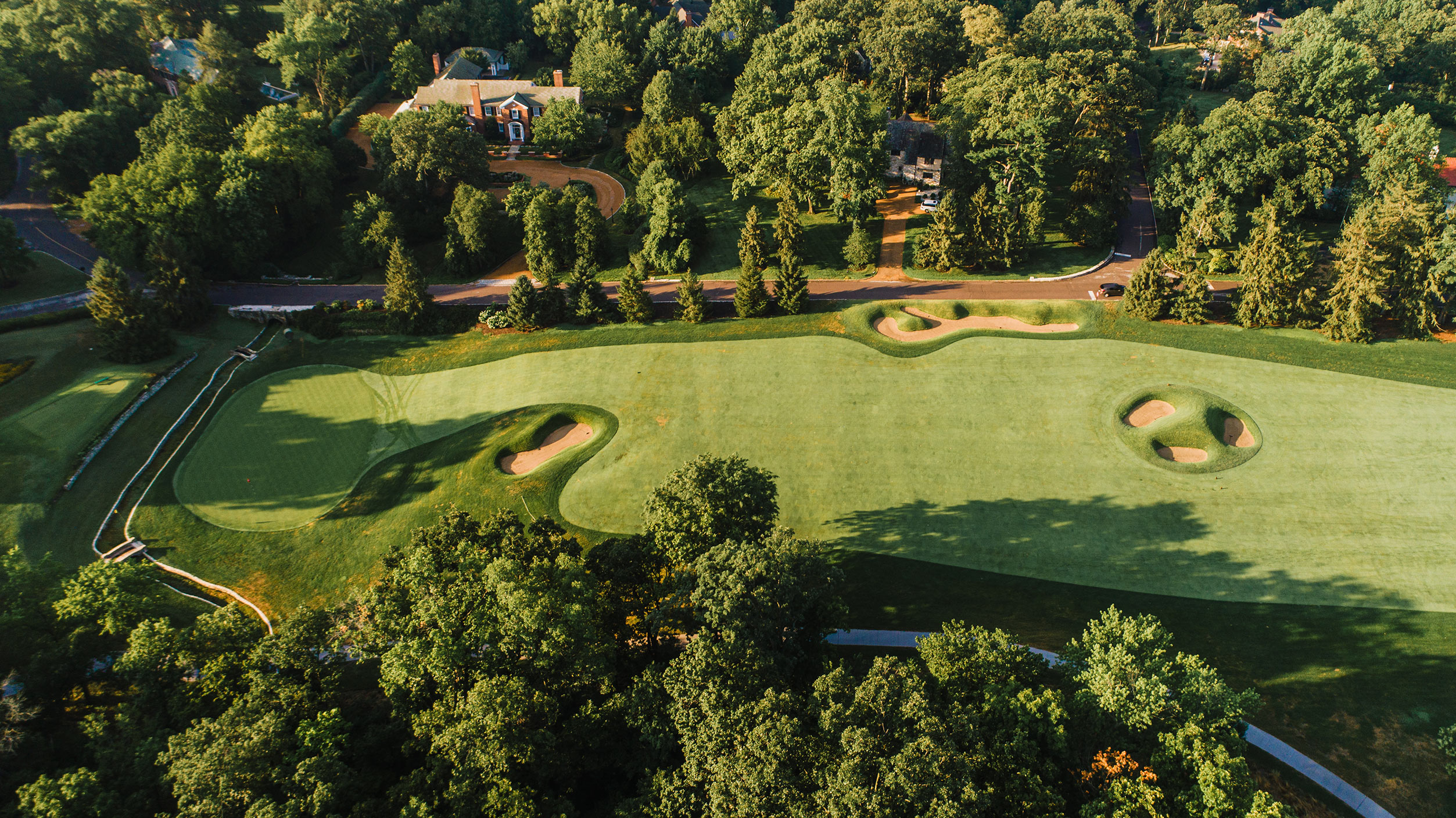
The restored fifth hole
