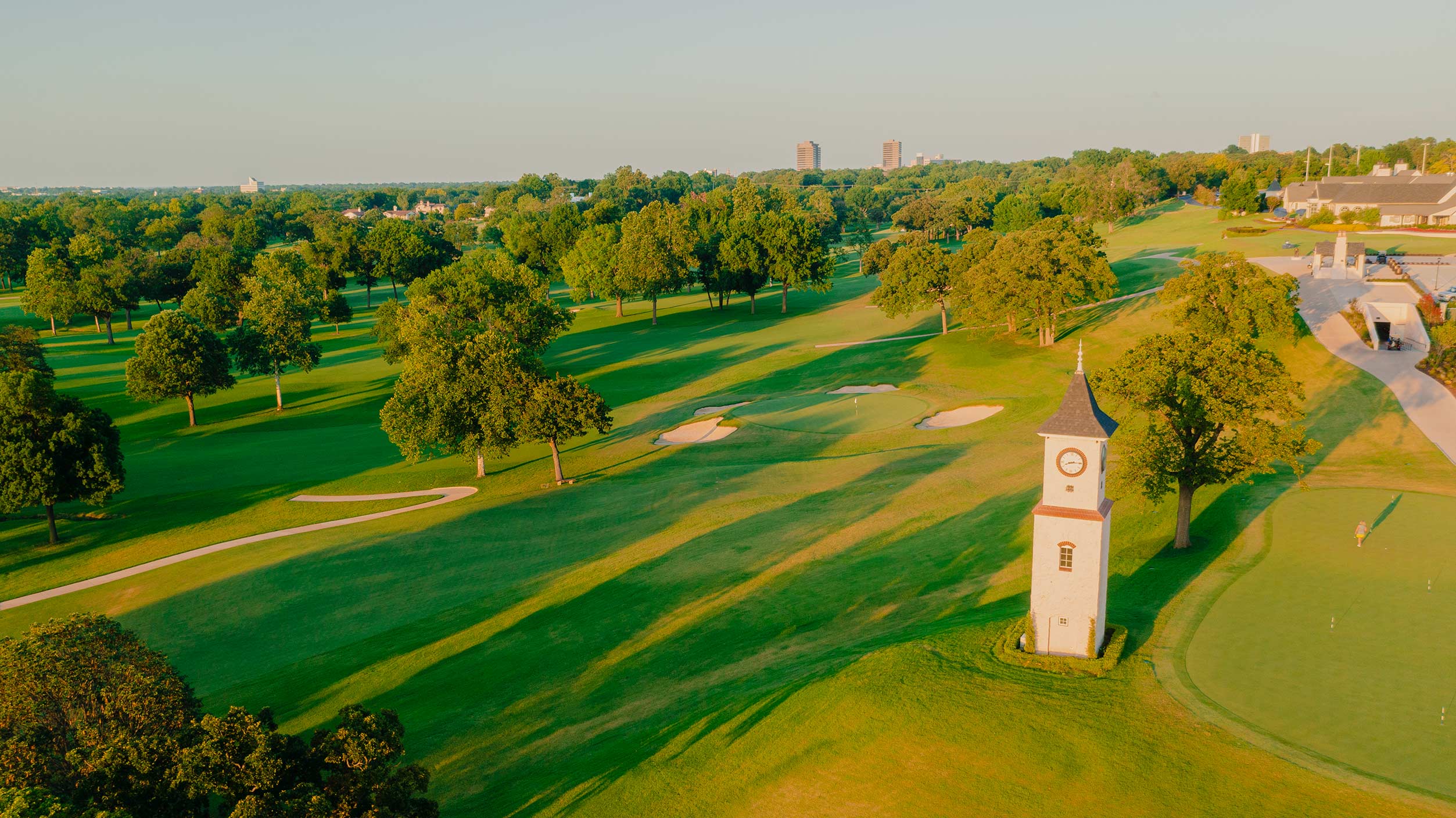
In the mid-1930s, not many world-class golf courses were being built in North America, much less in the drought-ravaged prairies. Yet in Tulsa, Oklahoma, approximately 150 local citizens had enough disposable income in 1935 to contribute $1,000 apiece to a new country club featuring a golf course designed by Perry Maxwell. Oil baron Waite Phillips donated a handsome, rolling property, and Maxwell, along with his brother-in-law and construction supervisor Dean Woods, drew on Works Progress Administration labor to create a tournament-worthy golf course. Southern Hills Country Club opened in 1936, and starting with the 1946 U.S. Women’s Amateur, it hosted many national championships, including the U.S. Open in 1958, 1977, and 2001. Next week, the club will stage its second U.S. Women’s Amateur.
In preparation for the 1958 U.S. Open, Robert Trent Jones revised a few holes but warned against additional alterations. “You’ve got one of the greatest golf courses in the world,” Jones told the club, according to Chris Clouser’s Maxwell biography. “You’d be a fool to let anyone make further changes.” By the 1990s, Southern Hills had become over-treed, and its bunkers and greens had lost much of their original character. In the early 2000s, architect Keith Foster oversaw tree removal, fairway widening, and green restoration. Then, in preparation for the 2022 PGA Championship, Gil Hanse conducted an ambitious “historical renovation,” restoring many aspects of Maxwell’s design while also making accommodations for modern championship golf.
{{content-block-course-profile-southern-hills-country-club-001}}
Take Note…
Life in the transition zone. Oklahoma has always been a tricky place to grow golf turf. Much of the state sits in the “transition zone” between the Northern U.S., where cool-season grasses predominate, and the South, where warm-season varieties thrive. Since Oklahoma tends to be too warm for bentgrass and too cold for Bermudagrass, many of the state’s early courses, including a number designed by Perry Maxwell, originally had sand greens. At Southern Hills, however, a state-of-the-art (for the 1930s) irrigation system allowed the course to be sown with bent from tee to green—a first for the region. The club later converted the fairways and roughs to Bermuda, but the greens retained their bent surfaces, now assisted through cold winters and hot summers by PrecisionAire hydronics.
The West Nine. A long-standing rumor holds that Perry Maxwell initially designed 27 holes at Southern Hills. No plans exist for the additional nine, but in 1992 the club hired Coore & Crenshaw to create a Maxwell-styled nine-hole course on an open plot west of the clubhouse. The West Nine, as it is now known, was built to resemble Southern Hills’ championship course as it stood in the early 1990s. If Coore & Crenshaw were brought back to renovate their work, I assume they would dispense with the existing saucer-shaped bunkers in favor of something more authentically Maxwellian.
From ball dispenser to icon. The clock tower next to Southern Hills’ practice green is now famous enough to have featured on the logo for the 2022 PGA Championship. It has stood only since the 1990s, however, when it replaced a smaller structure that housed a range-ball dispenser.