Pebble Beach has the most convoluted architectural history of any iconic American golf course aside from Augusta National. Douglas Grant and Jack Neville established the course’s figure-eight routing in 1919, but their rudimentary finish work didn’t last long. Herbert Fowler extended the 18th hole from a 379-yard par 4 to one of the world’s greatest par 5s in 1921, and Alister MacKenzie rebuilt the eighth and 13th greens to striking effect in 1926. In preparation for the 1929 amateur, MacKenzie associates H. Chandler Egan and Robert Hunter overhauled the rest of the greens and hazards, giving the course a strategic identity that it retains (more or less) to this day. Finally, in the late 90s, Jack Nicklaus and Arnold Palmer did some stuff they probably shouldn’t have done. Nevertheless, Pebble Beach is a place all golfers should see before they die.
{{content-block-course-profile-pebble-beach-golf-links-001}}
Take Note…
An old fairway. The ninth hole at Pebble Beach once had a massive two-section fairway. Just the upper portion, away from the bluffs, remains today, but a lower area is still there, waiting to be mown out.
An old tee. To the right of the ninth green, hanging above Carmel Beach, is what used to be the primary 10th tee. This location turns the drive on No. 10 into a diagonal risk-reward proposition—of the kind you often find on Macdonald-Raynor “Cape” templates. (Obligatory caveat: what defines a Cape hole is the design of the green, not the angle of the tee shot.)
{{content-block-course-profile-pebble-beach-golf-links-002}}
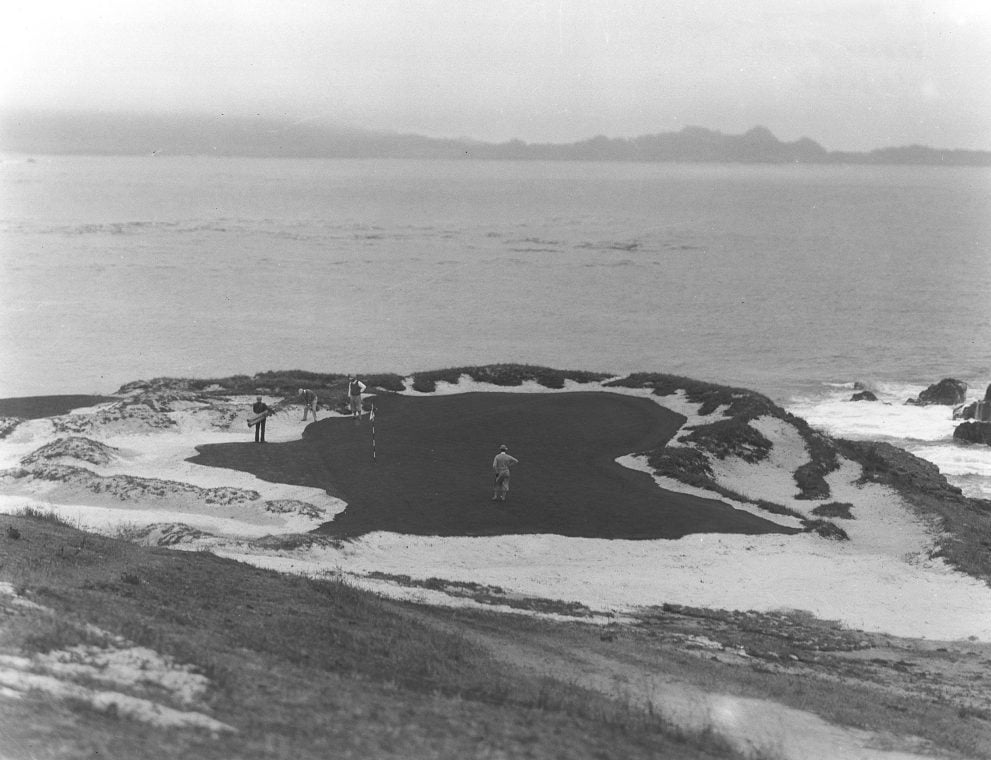
When restoration isn’t the way. It’s a social media tradition on Pebble Beach Pro-Am week: post a photo of the par-3 seventh hole as it appeared in the late 1920s, encircled by Chandler Egan’s faux dunes. I enjoy looking at these images as much as the next guy, but I don’t think the aesthetic works. Pebble Beach was built on clay and rock, not sand.
Poor man’s Pebble. If you go to Monterey but aren’t prepared to drop 10-15 benjamins on a round of golf, remember that coastal access is—or can be—free. Here’s what you do: at one of the Pebble Beach gates, lie to the ranger and say you’re playing golf so you don’t have to pay the entry fee; turn onto Palmero Way to enter the golf course property; stop at the kiosk and say “coastal access” to the attendant; park in the lot next to the 17th hole; and then, you know, just walk around. Hang out on the steps above Stillwater Cove. Look at the golf course. You’re at Pebble Beach.