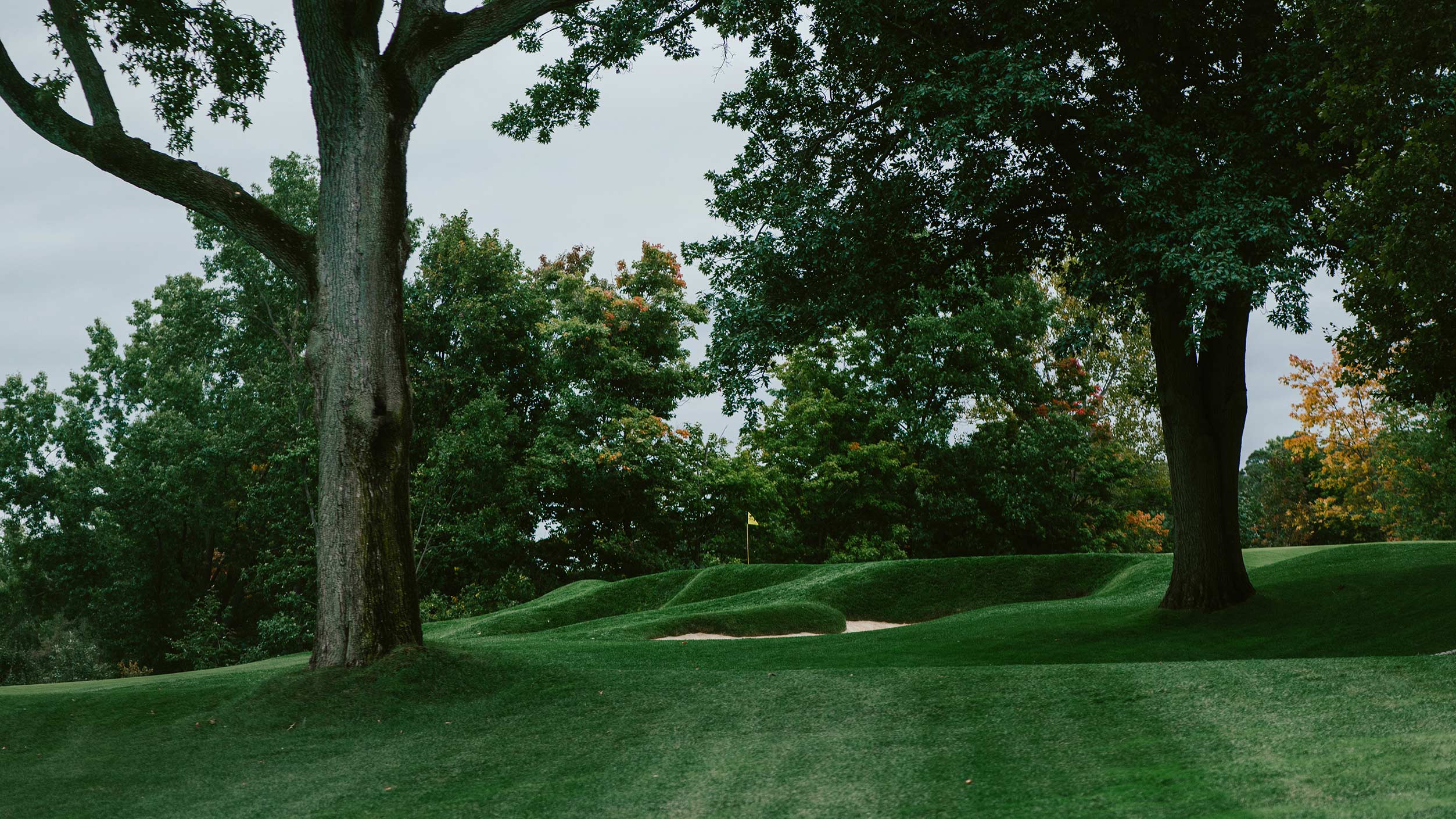
The East Course at Oak Hill Country Club has one of the sturdiest reputations in American golf. It has hosted three U.S. Opens, three PGA Championships, two U.S. Amateurs, and a Ryder Cup. It’s a mainstay in the top half of Golf Digest’s and Golf Magazine’s 100-greatest rankings. Yet by 2020, Oak Hill saw fit to hire Andrew Green to give the East a Donald Ross-inspired makeover. The course had changed a great deal in the preceding years: Robert Trent Jones renovated it at the height of his “Open Doctor” fame in the 1950s, and George and Tom Fazio monkeyed with it further in 1976. Green undid much of that work, bringing back the aesthetics and dimensions of Ross’s bunkers and greens. In other ways, the East remains stuck in the middle: a modern championship venue with some classic flourishes; a restored Golden Age design that lacks many of its original traits.
{{content-block-course-profile-oak-hill-country-club-east-course-001}}
Take Note…
It’s right there in the name. Tree plantings are a core part of Oak Hill’s identity. When the club moved to its current site, the courses sat on open farmland. An early member, the physician and amateur horticulturalist John R. Williams, set out to beautify the property with maples, evergreens, elms, and—of course—oaks. “The Almighty was the greatest landscape architect of all,” he said. “It was his plan to have oaks at Oak Hill.” You can’t argue with a divine warrant! Later, Williams would say that he lost count at 75,000 seedlings planted. Thatescalatedquickly.gif.
Rosstown. Next door to Oak Hill and visible from parts of the East Course is Irondequoit Country Club, a 1916 Donald Ross design. About a mile northwest is the Country Club of Rochester, which Ross expanded to 18 holes in 1913. Two miles southeast is Monroe Golf Club, a 1923 Ross effort. Rumors persist that ol’ Donny had a mistress—or two, or several—in the city.