Desert Forest Golf Club, designed by Red Lawrence in 1962, is often called the first desert golf course. While this isn’t literally true, Desert Forest does have a strong claim to being the first desert course in the United States to embrace its setting rather than imposing a parkland aesthetic on a desert landscape. This naturalness may not have been a deliberate design choice—more likely it was the result of a paltry budget—but either way, the effect is lovely and unique. Lawrence did minimal earthmoving on the fairways, allowing them to roll over the site’s excellent medium-scale topography. He created no artificial fairway bunkers, leaving the sand and flora of the Sonora Desert as the only hazards for tee shots. The main weakness of the original layout was the repetitive nature of its small, perched putting surfaces. In 2013, the club hired Dave Zinkand, a former Coore & Crenshaw associate, to upgrade the greens and make various other changes. Today, the combination of Lawrence’s stellar routing and Zinkand’s green complexes—still small and perched, but now possessing a great deal more character and variety—makes Desert Forest one of the finest mid-20th century American courses.
{{content-block-course-profile-desert-forest-golf-club-001}}
Take Note…
Samey samey. To illustrate how similar Desert Forest’s original greens were to each other, Dave Zinkand told me that the club’s newsletter used to have a regular feature where members were challenged to identify a particular green from a photo. Often they would guess wrong. “Imagine stumping an entire membership about an image of one of their own holes,” Zinkand mused. It’s a sign of the success of his renovation, he believes, that the newsletter no longer runs this contest.
Flip my nines back and forth. Early in Desert Forest’s life, the nines were flipped. According to the green committee member who hosted us, the club did this because today’s eighth and ninth holes—the original 17th and 18th—play into the setting sun. The change didn’t harm the cadence of the course. Today’s ninth and 18th holes are both dramatic enough to serve as finishers, and the two nines close with similar sequences of pars (front: 4-5-3-5; back: 4-5-3-4). The only advantage of the original numbering is that the current seventh hole, a dramatic risk-reward par 5 (described below), would work even better toward the end of the round as a potential match-decider.
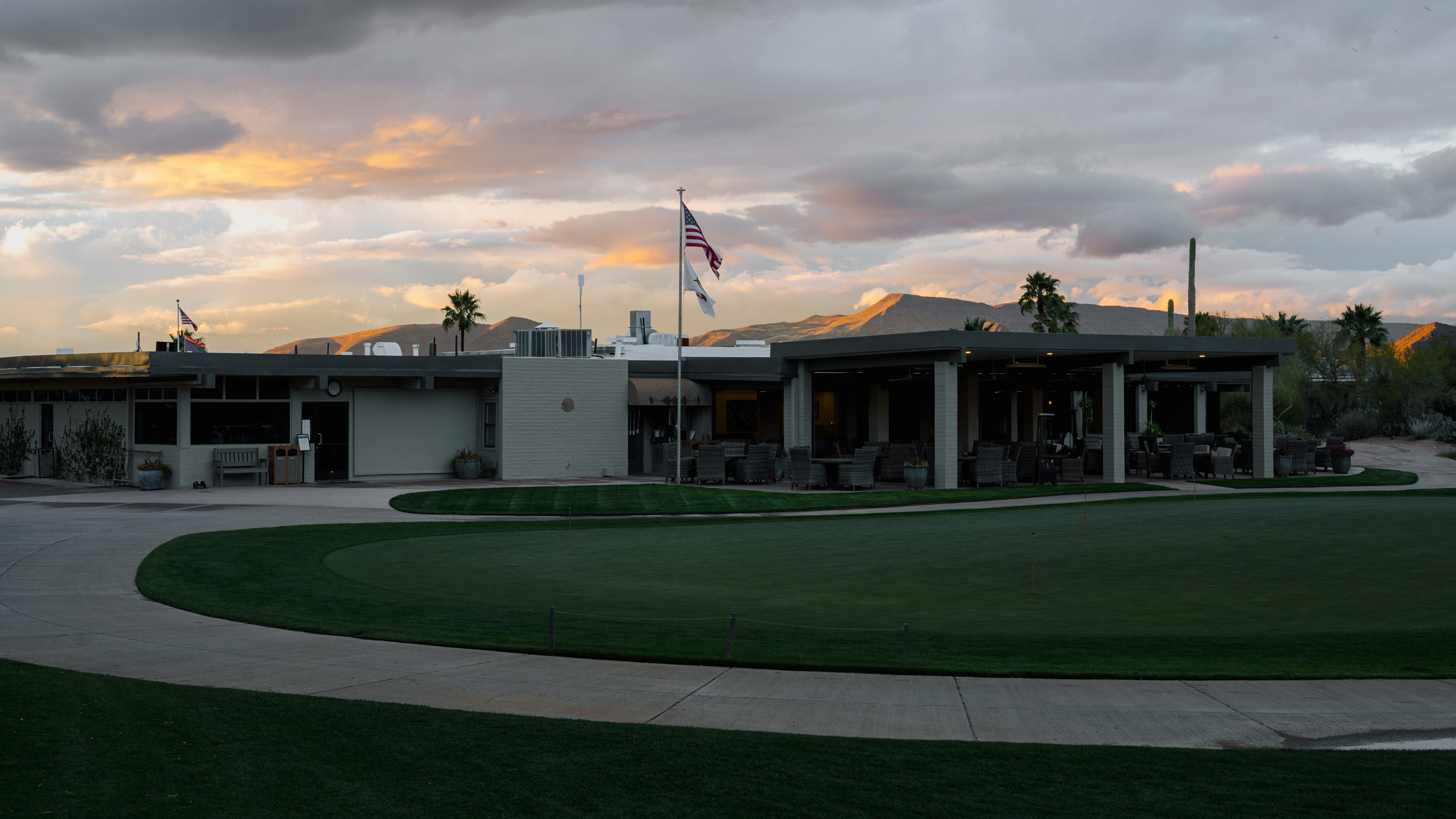
A touch of class. Desert Forest has one of my favorite clubhouses anywhere: relatively small and low-slung, distinctly midcentury in style, and well suited to the sturdy elegance of Red Lawrence’s post-World War II golf architecture. Dear other clubhouses: what’s preventing you from looking like this?