Chambers Bay Golf Course is the last of an extinct species: a public golf facility built for the express purpose of hosting a national championship. Developed and owned by Pierce County, Washington, Chambers Bay is the centerpiece of the nearly 1,000-acre Chambers Creek Regional Park, which also includes trails, recreational fields, and a children’s playground. The property, located on the shoreline of Puget Sound, had been a degraded and abandoned sand and gravel mine before the county purchased it for $33 million in 1992. A decade later, inspired by the transformation of the Black course at New York’s Bethpage State Park into an elite tournament venue, Pierce County executives hired Robert Trent Jones Jr. to turn a portion of the quarry into a links-style golf course capable of hosting a U.S. Open. Led on site by chief design officer Bruce Charlton and project architect Jay Blasi, Jones’s firm completed its work in 2007. Chambers Bay went on to host the 2010 U.S. Amateur, the 2015 U.S. Open, and the 2022 U.S. Women’s Amateur. For now, however, the course appears to be out of the U.S. Open rotation, and county leaders have begun to consider striking a deal with LIV Golf.
{{content-block-course-profile-chambers-bay-001}}
Take Note…
The Poa transition. Chambers Bay was initially planted with fescue from tee to green, with a small percentage of colonial bentgrass on the putting surfaces. A few years into the course’s life, however, annual bluegrass, more commonly known as Poa annua, began to invade the greens. (The same transition has occurred recently at Bandon Dunes, as Andy Johnson recounted in this May edition of Design Notebook.) During the 2015 U.S. Open, Chambers Bay’s greens struggled: while the fescue turned brown in response to heat, the Poa greened up, resulting in a mottled look criticized by many viewers and players. Partly in response to this controversy, but mostly as a concession to the inevitable, Chambers Bay decided to regrass all 18 of its greens with 100% Poa annua between 2017 and 2019.
Walking the walk. The heavily trafficked trail winding through Chambers Bay is a model of combining golf with a public park. It’s safe to use (errant shots rarely threaten walkers, runners, and bikers), doesn’t interfere with the golf (players encounter it only three times during the round, and all of the crossings are between greens and tees), and turns the golf course property into a shared space—a true community asset.
Pieces of the past. The massive concrete structures next to the 18th fairway are the remnants of sorting bins used by the mining operation that once occupied the site. Keeping them was a smart decision; they now lend the course a unique, historically specific sense of place.
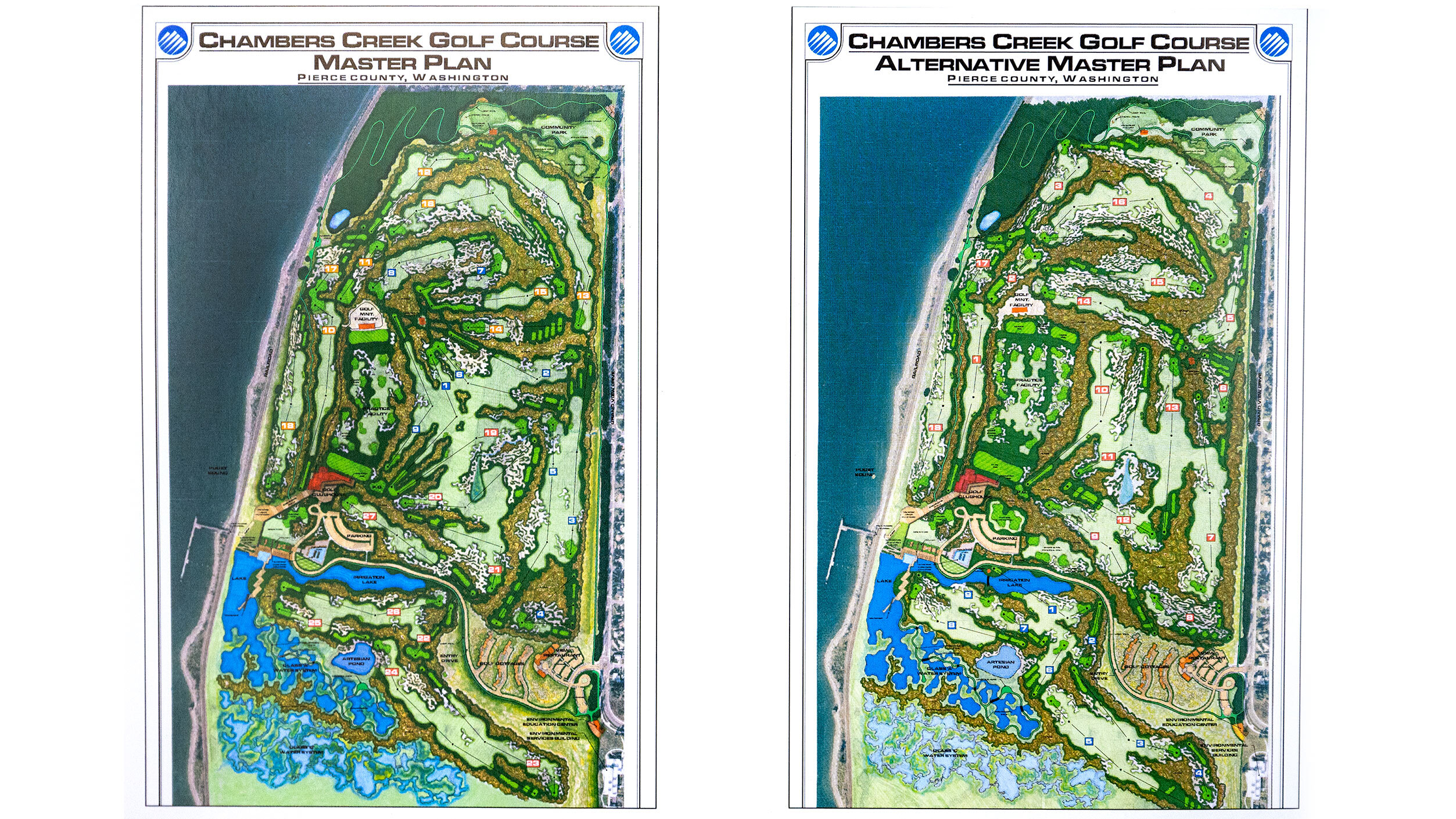
Paths not taken. During the design process, RTJII proposed several different routings for Chambers Bay, including the two 27-hole versions below.